You've probably done the same thing most players do at the start. You buy a starter deck, shuffle it up, play a few games, then stare at your binder and wonder what comes next. You can tell some cards feel strong, some hands feel clunky, and some matches seem unwinnable, but turning that feeling into a proper deck Pokémon TCG list isn't obvious at first.
That gap between “I've got cards” and “I've got a deck” is where many players either get hooked or give up. The good news is that deck building isn't a secret club skill. It's a repeatable loop. You pick a plan, find the exact cards that support it, test the list, and trim what keeps getting in the way. That's true whether you want a kitchen-table build, a local league list, or something sharper for tournament play in the UK.
Table of Contents
- From Starter Deck to Custom Creation
- The Anatomy of a Great Pokémon Deck
- Choosing Your Strategy and Core Pokémon
- Sourcing Your Cards with WheelyNerdy
- Playtesting and Tuning Your Deck
- Final Checks and Your First Tournament
From Starter Deck to Custom Creation
Most custom decks start with a small moment of friction. A starter deck keeps drawing the wrong half. Your favourite attacker is good when it lands, but the list around it doesn't help it get there. Or you realise you keep losing not because you misplayed, but because the deck asks you to top-deck the right card too often.
That's the point where deck building gets fun.
A player I know started with a pre-constructed list, liked one attacker, hated two others, and kept swapping random cards in and out. The deck got worse before it got better. What fixed it wasn't adding “stronger” cards. It was choosing a clear plan, then cutting anything that didn't help that plan happen more often.
If you're at that stage, don't start by rebuilding everything from scratch. Start by asking three plain questions:
- What wins me games: One attacker, a spread plan, prize trading, disruption, or a late-game closer?
- Which cards feel dead in hand: If you hate seeing a card early and hate seeing it late, it probably doesn't belong.
- What am I searching for every game: Those are usually the cards that deserve more copies.
Building a deck isn't about stuffing in your favourite sixty cards. It's about making the same strong turn happen often enough that you can rely on it.
A good next step is importing a rough list and seeing it written clearly, rather than spread across your desk. A simple list manager like the deck import tool at WheelyNerdy helps turn a pile of ideas into something you can review, trim, and test.
Custom creation doesn't mean originality for its own sake, either. Some of the best early decks are just edited starter shells. Cut the filler. Raise the counts of the cards that matter. Add better search, better draw, and a cleaner route to your main attacker. That's usually where a real deck Pokémon TCG build begins.
The Anatomy of a Great Pokémon Deck
Strong decks don't just contain good cards. They organise those cards so you can reach them when the game asks for them.
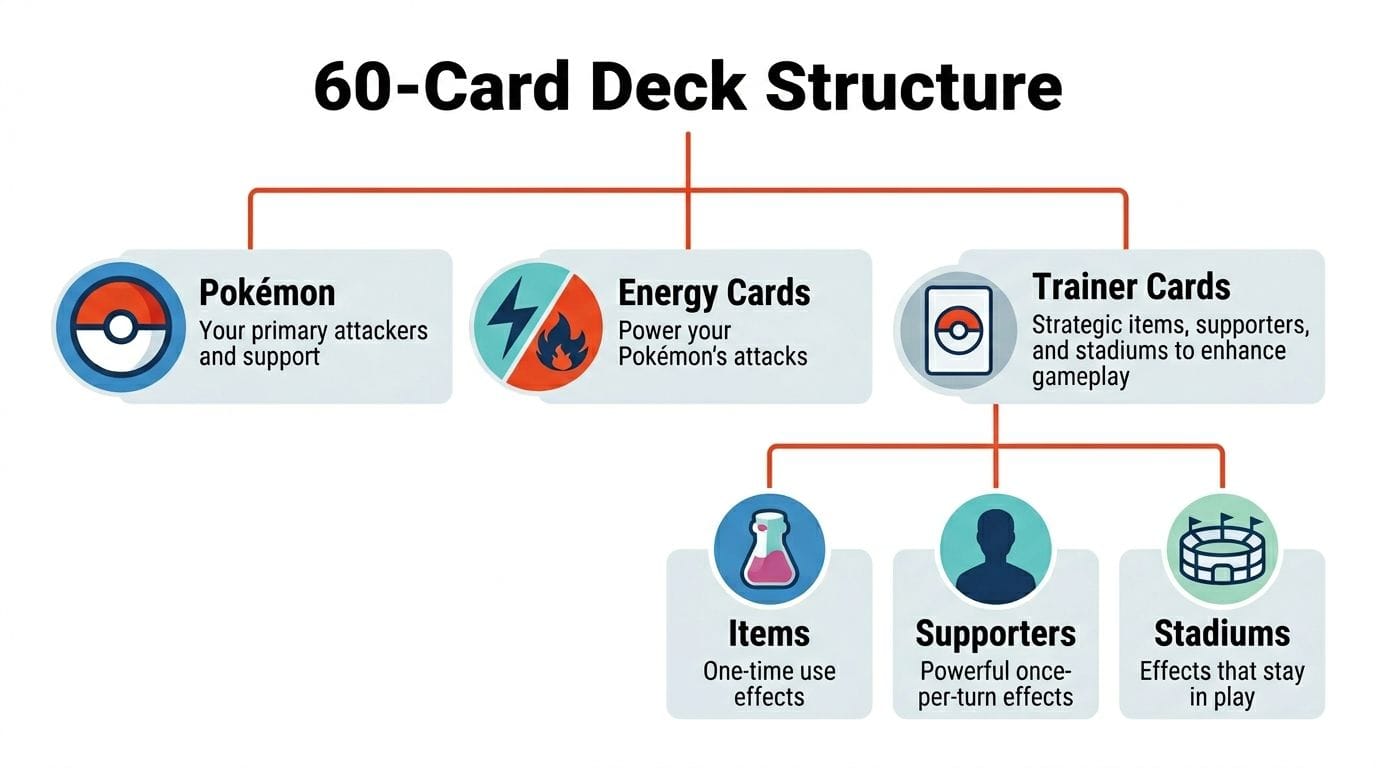
In official Pokémon TCG tournaments, the most successful competitive decks consistently follow a 60-card structure of 15 to 20 Pokémon, 20 to 30 Trainer cards, and 8 to 12 Energy cards, and competitive analysis shows that running four copies of key cards increases draw probability by approximately 10% compared with two-copy variants, according to Ultimate Guard's deck building guide.
Why the core ratios matter
That ratio isn't a style preference. It's a consistency framework.
Newer players often overload on Pokémon because Pokémon feel like the deck's identity. In practice, too many Pokémon can clog your hand with pieces you can't deploy efficiently. The list starts doing less because it has less search, less draw, and fewer switching or recovery options.
On the other side, some players trim Energy too hard because they've heard competitive lists run lean. That can work, but only if your Trainers and Pokémon engine reliably find those Energy cards when needed. If your list can't support that, the deck stalls.
A simple way to view it:
| Deck part | Typical role | What goes wrong when you overdo it |
|---|---|---|
| Pokémon | Attackers, support, setup pieces | Too many evolving lines or situational basics create awkward starts |
| Trainer cards | Search, draw, gust, switching, recovery | Too few Trainers makes the whole deck inconsistent |
| Energy | Fuels attacks and retreat costs | Too much Energy replaces useful action cards |
What each card type should do
A cleaner deck Pokémon TCG list usually gives every inclusion a job.
Pokémon should have defined roles
Your Pokémon aren't all there to attack. Some are your main attacker. Some are backup attackers for awkward prize maps. Some exist purely to search, draw, pivot, or enable an evolution line.
If a Pokémon has no clear role, it's often the first cut.
Look for roles like these:
- Primary attacker: The card you expect to win with in most games.
- Secondary attacker: Covers a bad matchup or attacks when the main plan is disrupted.
- Setup support: Helps you find basics, evolve, or stabilise the opening turns.
- Utility pivot: Gives you a sensible active Pokémon while you prepare the board.
Trainer cards are the real engine
Most weak decks don't lose because the attacker is bad. They lose because the deck can't assemble the board on time.
That's why Trainer cards take up such a large share of successful lists. They smooth out the game. They find your basics, discard what you want in the discard pile, draw into combo pieces, switch your board, and recover key resources after trades.
Practical rule: If a card doesn't help you set up, attack, recover, or disrupt, it needs a very good reason to stay in the list.
Energy should match your real demands
Energy counts should follow your attack costs, not your nerves. If your main attacker needs one Energy and your search engine is strong, you can often stay compact. If your plan needs repeated attachments across multiple attackers, you need enough fuel to support that.
A useful check is to fan out your opening hands over several test draws. If you're constantly happy to see one Energy but frustrated by the third or fourth, the count may be too high. If you're regularly opening with no path to attack on schedule, it may be too low.
The best decks feel boring in the right way. They open similarly, hit their setup pieces often, and don't ask for miracles. That's what a solid structure gives you.
Choosing Your Strategy and Core Pokémon
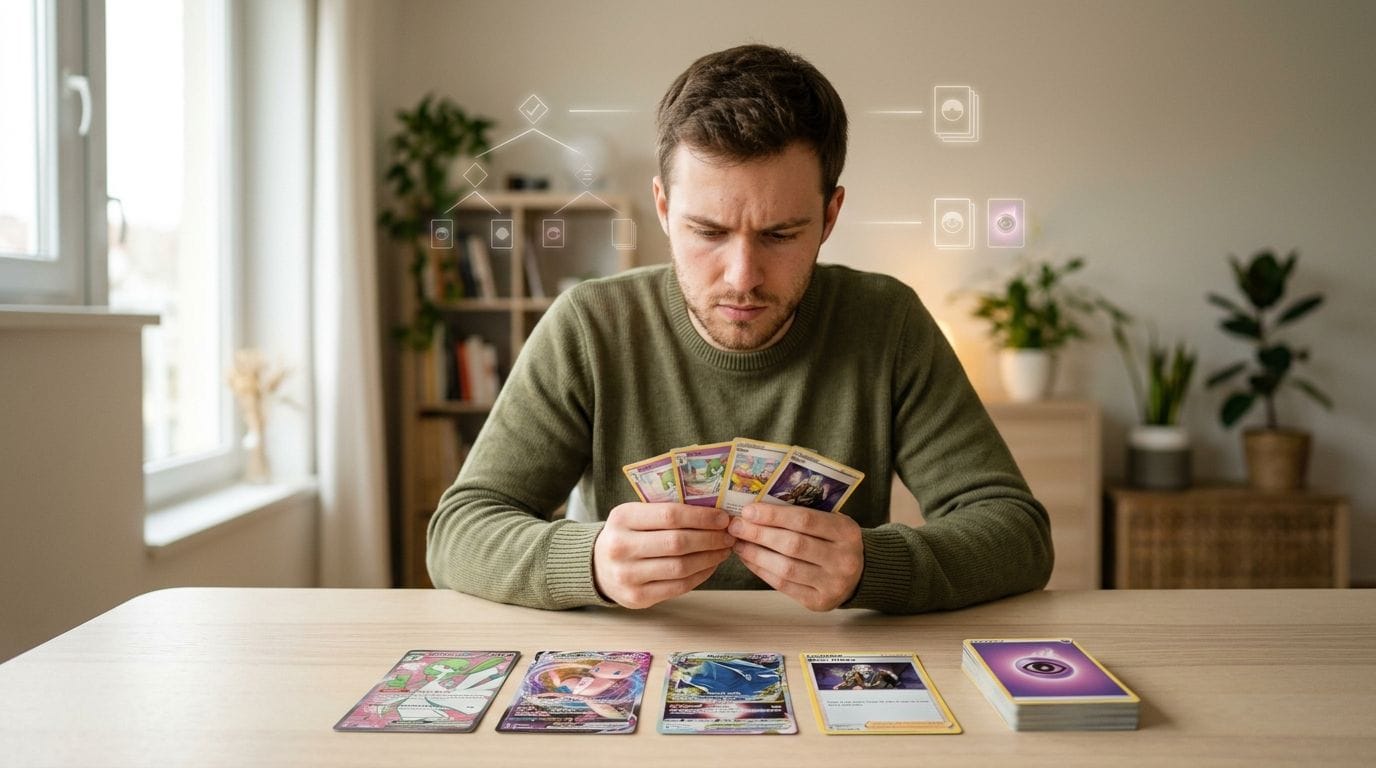
Most deck-building mistakes happen before the first card slot is even chosen. Players start with a cool card, then add other cool cards, and only later realise the deck has no coherent route to winning.
Pick the route first.
Start with a win condition
Your win condition is the thing your deck is built to do repeatedly enough to take prizes before the opponent stabilises. That might be fast pressure, durable attackers, a spread plan, a two-hit trade that favours you, or a disruptive board state that buys time for a finisher.
When I build from scratch, I usually sort candidate cards into three piles:
- Cards I want to win with
- Cards that make those attackers function
- Cards that only look interesting
That third pile is where bloat lives.
A few broad strategy types help when you're deciding what kind of deck Pokémon TCG list you enjoy piloting:
- Fast pressure decks try to attack early and keep the opponent reacting.
- Big attacker decks accept a slower setup in exchange for stronger hits or bulk.
- Evolution engines trade speed for layered power and mid-game stability.
- Disruption or control builds win by limiting options, stretching turns, and forcing awkward sequencing.
None of those archetypes is automatically right for you. The right one is the one you can pilot cleanly under pressure.
Build for your local reality, not just the internet
This matters more than people think. Online popularity doesn't always map cleanly to what you'll face at local leagues, cups, or regional prep sessions in the UK.
UK-specific data from the British Pokémon TCG League for 2024 to 2025 shows that only 12% of top-10 UK tournament finalists used the internationally popular Darkrai EX Magnezone deck, while Armarouge Box and Porygon-Z strategies accounted for 48% of UK competitive play, based on the British Pokémon TCG League's local meta discussion.
That doesn't mean the global favourite is bad. It means blind copying can be a mistake.
If your local room is full of players on setup-heavy evolution decks, your list needs a plan for early pressure or targeted disruption. If your locals favour resilient, grindy boards, a fragile glass-cannon list may feel amazing online and awful in person.
A useful filter is this short comparison:
| Question | If the answer is yes | If the answer is no |
|---|---|---|
| Can this deck execute its plan when going second? | Keep testing it | Add more setup or reconsider the shell |
| Does it have a fallback attacker? | You're less likely to fold to one knockout | You may be overbuilt around one line |
| Can I explain how it wins in one sentence? | The plan is probably clear enough | The deck may be doing too many things |
Don’t choose a deck because people call it the best. Choose it because you understand what it punishes, what it loses to, and how you want to sequence the first few turns.
Watch strong players make these decisions
Seeing the choices in motion helps. Pay attention to how experienced players define their active plan, hold resources, and avoid filling lists with cards that don’t contribute to that plan.
The main thing to notice isn’t just the card names. It’s the restraint. Strong lists usually cut the “nice to have” cards and protect the cards that start, stabilise, or close the game. That’s the part newer builders often miss.
Sourcing Your Cards with WheelyNerdy
Once your list makes sense on paper, the next bottleneck is sourcing. Many players waste money in the sourcing stage. They know the attacker they want, but they search too broadly, buy too early, or chase cards through random listings without checking whether the rest of the deck can be built efficiently around them.
A set-based catalogue helps because it gives your search some shape.
Browse by set, then by role
If your core Pokémon comes from a specific release, start there. Browsing by set makes the search less abstract, especially when you’re still learning card pools and release groupings. You’re not typing vague terms and hoping. You’re narrowing the field to the environment that card came from, then checking support pieces and adjacent options.
That’s where a tool like the WheelyNerdy deck builder fits naturally. It sits next to a set-organised catalogue, so you can sketch a list, check card availability, compare versions, and see what’s missing without bouncing between unrelated tools.
This is a practical way to source:
- Start with the core line: Main attacker, evolution chain if needed, and mandatory support Pokémon.
- Add the engine second: Search cards, draw cards, switching cards, recovery, and gust effects.
- Leave flex slots for last: Tech attackers and narrow answers should come after the shell is stable.
If a card only matters in one fringe situation, don’t buy it before you’ve secured the cards that make your opening turns work.
Buy singles with a list, not with hope
Targeted buying matters in the UK because card pricing isn’t evenly distributed. Data from the UK Card Market Association in 2025 shows a 34% price variance in Pokémon singles across UK regions, and players can overpay by an estimated £15 to £25 per deck without a sensible sourcing plan, as noted in this UK cost discussion tied to Pokémon TCG Pocket deck strategy.
That doesn’t mean every cheap listing is the right purchase. Condition, print version, stock depth, and whether one seller can cover most of your list still matter. But it does mean your buying process should be deliberate.
A simple sourcing checklist helps:
- Build the full list first: Don’t start ordering when you only know half the deck.
- Prioritise playsets of core cards: The key consistency pieces matter more than flashy one-ofs.
- Check the set printing you want: Especially if you care about matching versions or legal printings.
- Group orders where possible: Fewer fragmented purchases usually means less hassle.
Booster packs are fun. They’re just not a reliable way to finish a deck. If you need exact counts for a functional list, singles are the straightforward path.
Playtesting and Tuning Your Deck
A deck that hasn’t been tested is still an idea.
That sounds harsh, but it’s true. Plenty of lists look elegant in a deck builder and collapse the moment they hit awkward starts, prize issues, or an opponent who pressures them from a different angle than expected. Testing is where a theoretical build becomes a playable one.
The UK meta has seen a 23% increase in competitive deck diversity between June 2024 and June 2025, with over 130,066 unique decklists registered on global tracking platforms, according to Trainer Hill’s meta tracking data. That kind of spread is exactly why testing against one familiar matchup isn’t enough.
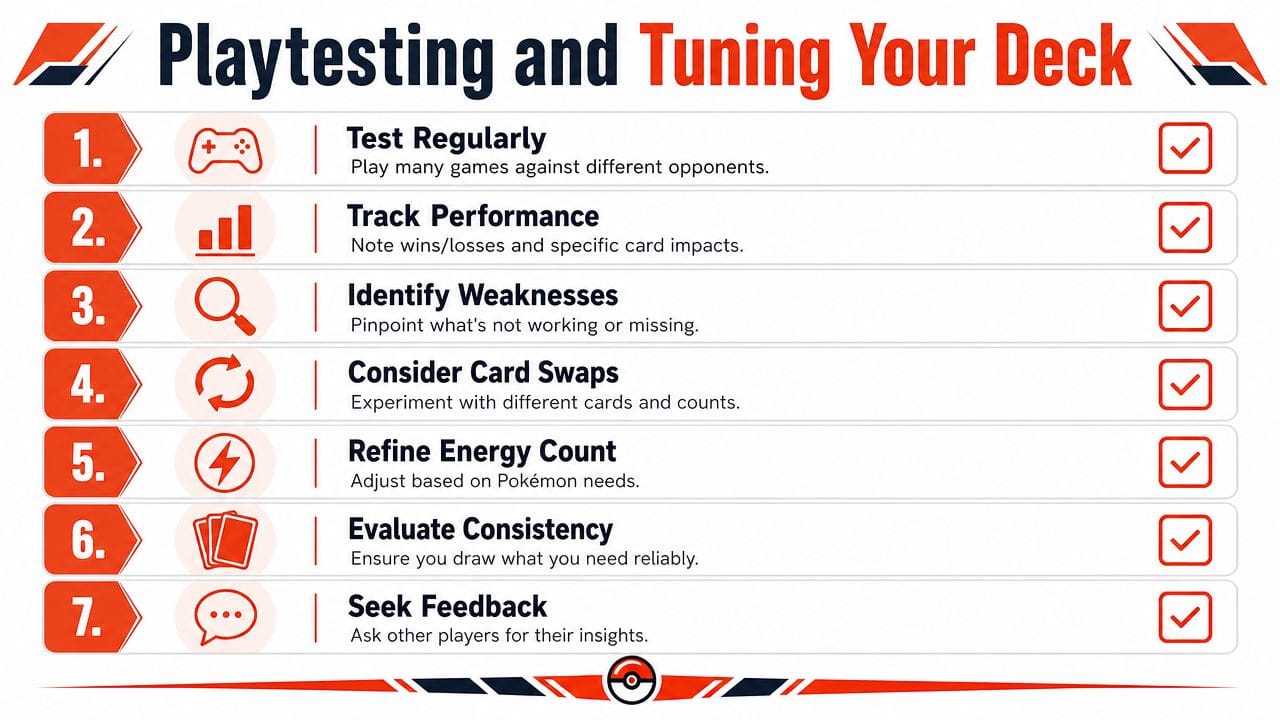
Test the deck in layers
Not every test game is trying to answer the same question. If you mix everything together, the results get muddy.
I prefer to split testing into three layers:
Solo consistency checks
This is the least glamorous part, but it saves time. Shuffle up, draw opening hands, and play out the first few turns without an opponent. You’re looking for repeated friction.
Ask things like:
- Can I find my starting Pokémon often enough?
- Do I reach my first meaningful attack on time?
- Which cards sit in hand without helping?
This kind of testing catches structural problems early. Too many cute inclusions. Too little search. Energy that shows up in clusters. Evolution pieces without access.
Focused matchup games
Once the opening turns look sensible, move to real opponents or proxies against known deck types. Don’t just track wins and losses. Track why games turned.
A loss because you prized a key card is different from a loss because the whole list folds to bench pressure. A win because the opponent bricked tells you less than a loss where your own sequencing worked but the matchup still felt rough.
Pressure test: If the same problem appears in multiple games, believe the pattern before you blame variance.
Stress tests after changes
After edits, don’t assume the deck improved. Verify it.
A common mistake is making five changes at once. That feels productive, but it hides cause and effect. If the deck improves, you won’t know which swap mattered. If it gets worse, you won’t know what broke it.
Change one thing at a time
Tuning works best when you’re stingy with changes.
Try a compact review loop like this:
| What you noticed | Likely issue | Small adjustment |
|---|---|---|
| Dead cards in hand | Too many niche inclusions | Cut one tech slot for a consistency card |
| Missing early attacks | Setup or Energy balance is off | Add access, not just more attackers |
| Board clogs quickly | Too many overlapping Pokémon roles | Trim support lines that duplicate jobs |
| Late game runs dry | Recovery or draw is too thin | Add one recovery or hand refresh option |
A tuned deck Pokémon TCG list usually gets tighter, not flashier. You remove cards that feel clever and keep cards that make the deck run on schedule.
Use other players’ lists as a pressure test
Testing in isolation has limits. You need a benchmark outside your own habits. Looking at public or shared community lists helps you see whether your counts are unusual for a good reason or just undercooked.
The community decks section on WheelyNerdy is useful for that sort of comparison because it lets you scan how other players structure lists, then compare your own choices against real builds. That doesn’t mean copying card for card. It means checking whether your skeleton makes sense.
Here’s the mindset I’d keep:
- Borrow structure, not identity: Another list can show you better counts without replacing your own strategy.
- Watch repeated inclusions: If many players solving a similar problem land on the same support package, pay attention.
- Keep notes after sessions: Memory is unreliable. Written notes make tuning decisions calmer and clearer.
The strongest improvement usually comes from small cuts and small upgrades repeated over time. That’s what turns a rough build into something you trust.
Final Checks and Your First Tournament
Before you sleeve up for league night or a local event, run one last legality and function check. This is the part people rush, and it’s the part that saves silly headaches.
Keep it simple:
- Count the deck carefully: It must be exactly 60 cards.
- Check copy limits: You can’t run more than four copies of any single card, excluding Basic Energy.
- Confirm your format: Make sure every card in the list is legal for the event you’re entering.
- Review your opening plan: Know what your ideal starter, first search target, and first attack look like.
- Pack the basics: Sleeves, damage counters, markers, and anything else the event expects you to have ready.
If you’re new to events, don’t put all the pressure on the result. Your first tournament is where you learn how your deck feels in timed rounds, how you handle nerves, and which cards you keep side-eyeing after each game. That information is valuable even if the record isn’t pretty.
A solid deck Pokémon TCG build isn’t one you finish once and never touch again. It’s one you understand well enough to adjust. If you can explain your win condition, source the right cards efficiently, and tune the list after real games, you’re already doing what experienced players do.
If you want one place to organise a list, browse cards by set, and check what you still need, WheelyNerdy offers a practical UK-based option for building and sourcing Pokémon TCG decks.